
Walk into any big-box kitchen store, and they’ll try to sell you a 22-piece knife block that includes everything from a serrated grapefruit knife to something that looks like it belongs in a medieval dungeon.
At Kyoku, we believe in the Samurai philosophy: Eliminate the unnecessary. A true master doesn’t need twenty mediocre blades; they need an elite arsenal of three. Whether you are a professional chef or a home cook finding your rhythm, these three knives will handle 99% of every task you will ever encounter.

1. The Gyuto (The General)
Role: The All-Purpose Workhorse.
If you were stranded on a culinary island and could only take one blade, this is it. The Gyuto is the Japanese version of the Western Chef’s knife. It is longer, leaner, and sharper.
- Why it’s essential: Its length (typically 8 inches) gives you the leverage to slice through large proteins, while the curved “belly” allows for a smooth rocking motion.
- The Kyoku Touch: Our Gyuto is balanced to feel weightless. It’s the “big brother” that handles the heavy lifting—from carving a roast to dicing a mountain of onions.
2. The Santoku (The Precision Expert)
Role: The High-Volume Chopper.
While the Gyuto is about power and reach, the Santoku knife is about speed and precision. Its name translates to “Three Virtues,” referring to its excellence in slicing, dicing, and mincing.
- Why it’s essential: The flatter edge is designed for a “push-cut” motion, which is much faster for vegetable prep. If you are making a stir-fry or a complex salad, the Santoku is your best friend.
- The Kyoku Touch: Most of our Santokus feature a Granton edge (the dimples on the side), which creates air pockets so starchy vegetables like potatoes don’t stick to the blade.
3. The Petty Knife (The Detail Surgeon)
Role: The Small-Task Specialist.
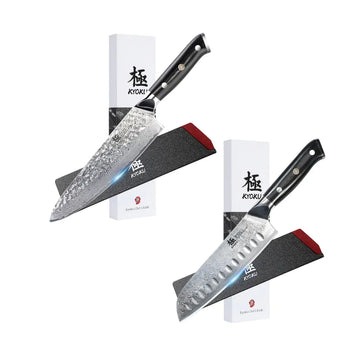
You don’t use a katana to peel a grape. The Petty knife is the companion blade (the Tantō) to your larger knives. It is essentially a paring knife on steroids—longer and more versatile.
- Why it’s essential: It’s for “off-board” work. Peeling fruit, de-veining shrimp, removing the “eyes” from potatoes, or finely mincing a single clove of garlic. It offers a level of control a large knife simply can’t provide.
- The Kyoku Touch: We sharpen our Petty knives to a staggering 15° angle, making them surgical instruments for the most delicate garnishes.
The Arsenal at a Glance
| Knife | Length | Best For… | The “Vibe” |
| Gyuto | 8″ – 10″ | Large proteins, melons, rocking cuts. | Powerful & Commanding |
| Santoku | 5″ – 7″ | Dense vegetable prep, push-chopping. | Fast & Rhythmic |
| Petty | 3″ – 6″ | Peeling, garnishing, small aromatics. | Nimble & Precise |
Why Quality Over Quantity?
Investing in these three high-end blades from our Shogun or Daimyo series will actually save you money (and counter space) in the long run. When you use a knife that draws from a legacy of Japanese bladesmithing, you aren’t just “cutting food”—you are engaging in a craft.
A sharp, balanced blade makes the kitchen a place of creativity rather than a place of chores.
About the Author


